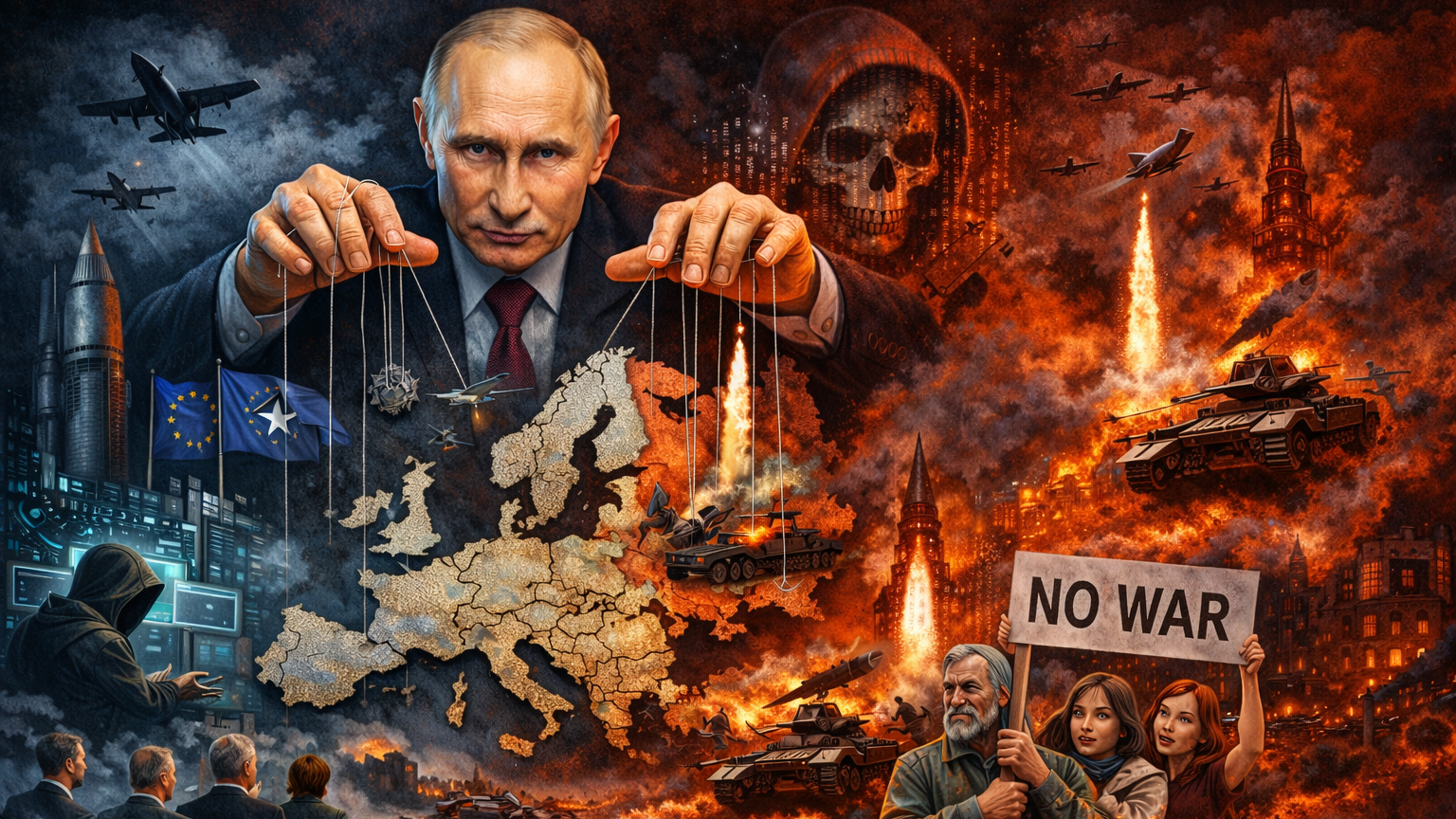
Putin's threats to Europe: anatomy of a great deception


Vladimir Putin has been threatening Europe for three years with the same language he used to threaten Ukraine in 2021. The only difference is that Europe thought it was a bluff then, but now it acts like it was unavoidable. In both cases, the mistake is the same. The first time, Europe underestimated reality; the second time, it overestimated fantasy.
In the meantime, the Russian state is engaged in an attrition-based war against a nation it had intended to destroy in a matter of days. That war is not being fought on the Rhine, the Vistula, or NATO's borders. The battle is taking place deep in eastern Ukraine, characterised by significant losses, improvisation, mass mobilisation, and a growing reliance on domestic repression. The Russian army is stranded in the trenches, relying on the mass mobilisation of prison recruits and ammunition from Iran and North Korea. This is not the image of a force about to march on Paris and Berlin. It is the image of a country trying not to lose the war it has already started in Ukraine.
Yet instead of this failure weakening the Russian threat in European perception, the opposite is happening: the weaker Russia is on the battlefield, the louder it is in the media.
This is no accident. It is the old logic of authoritarian regimes: when real power declines, symbolic power must shout.
And just at the moment when the difference between myth and reality is most obvious, Europe begins to act as if the myth is prevailing.
There is that scene in Monty Python and the Holy Grail where the knight, who has had both arms and one leg cut off, keeps shouting, "It's just a flesh wound!" and calls on his opponent to come back and fight "like a man." The scene is funny because it is absurd. But it would be even funnier if the audience began to seriously consider whether that knight really posed an existential threat.
Europe today, unfortunately, is doing just that.
Vladimir Putin has been threatening war with Europe for years. He threatens Britain, France, Germany, and Poland. He threatens NATO. He threatens the "collective West". He threatens a nuclear response, "unprecedented escalation", and "historic consequences". The longer the war in Ukraine continues, the greater the Russian losses. The more distant the goals become, the more theatrical the threats grow.
Let us repeat: Russia has been waging war against a single country for the fourth year. Not against a bloc. Not against an alliance. Not against a continent. Against Ukraine. The war, which was supposed to last several days, has turned into an exhausting conflict in which Moscow is losing men, technology, and strategic initiative, while simultaneously trying to convince the world that it is ready for war with all of Europe.
But this is not even a strategy. It is a bluff that relies on the opponent not looking at the cards. However, if the cards are examined, the game ends.
All this would be merely grotesque. What is becoming dangerous is that part of the European public and political elite begins to treat these threats as a real military projection, rather than as what they are: a substitute for a power that does not exist.
To understand this, it is necessary to do what propaganda hates most: stop, examine the balance of forces, and ask a brutally simple question: How exactly can Russia, unable to defeat Ukraine for the fourth year, think it could wage a war against Europe?
Let us begin with the most basic aspect – demographics. The Russian Federation has about 145 million inhabitants. The European Union, excluding the United Kingdom, has well over 440 million. Including Britain, Norway, and other European countries that are not EU members, Europe has a population of half a billion. This is not a mere statistical detail; it is the fundamental condition for sustaining a long-term, high-intensity war.
The economic disparity is even more striking. Russia's gross domestic product is about $2.2 trillion, while the European Union's exceeds $17 trillion. With the British economy included the difference approaches nine to one! Wars are not won by speeches but by factories, supply chains, energy, and finance. In this respect, Russia does not stand as an equal opponent to Europe, but as a country already struggling to finance the war it is currently waging.
Military budgets confirm this without hesitation. In 2024, Russia allocated around $110–$120 billion for defence, including war economy measures and hidden bookkeeping. In the same year, European countries collectively spent more than $690 billion. Even without the US contribution, European military spending is many times higher than Russia's. This translates into more production lines, more spare parts, more training, and – crucially – a greater capacity to sustain prolonged conflict.
On paper, Russia likes to present itself as a military superpower. In reality, its military strength is eroding on the front in Ukraine.
Currently, the Russian armed forces have around 1.3–1.5 million active and mobilised soldiers, including reservists called up since 2022. European countries, excluding the United States, have more than 1.8 million active members of the armed forces. Include the United Kingdom and other European NATO countries, and the number surpasses 2 million. The difference lies not only in numbers but also in the fact that European armies are extremely modernly equipped and not worn out by years of war.
The air force further dispels the myth of Russian supremacy. Russia possessed approximately 4,100 military aircraft, encompassing both planes and helicopters. It lost over 800 aircraft in Ukraine. Together, the seven largest European air forces - France, Germany, the United Kingdom, Italy, Spain, Poland, and Greece - possess over 4,600 aircraft. The difference becomes even more pronounced when considering the rest of Europe. A further, and indeed key, difference is that Russian aviation has been engaged in real warfare for three years, suffering losses it cannot easily replace and is unable to maintain its fleet regularly.
At sea, the story becomes a caricature. The Russian Navy has about 420 vessels, while European navies together have more than 2,000. Europe has six active aircraft carriers; Russia has one. That single carrier spends more years in overhaul than in operational use. To speak of Russian naval power projection against Europe is to seriously underestimate the intelligence of readers.
Ground forces, often presented as Russia's trump card, also do not withstand scrutiny. Russia entered the war with about 3,000 to 3,500 operational tanks. To date, it has lost more than 2,500. European countries together have over 5,000 of the most modern tanks, with an incomparably stronger industrial and repair base. The difference is simple: Russia turns its tanks into wreckage; Europe keeps them in hangars.
And then we come to the point that European fears persistently ignore: Ukraine.
Three years of war have made Ukraine what European armies have not had to become for decades: a combat-experienced, adaptive army accustomed to modern, high-intensity warfare. Today, the Ukrainian army has hundreds of thousands of soldiers – close to a million – who have experienced real combat operations against Russia. It has developed its own production of drones, missiles, and ammunition, adapted Western techniques, and built doctrine on the fly. It is not an abstract factor of the future; it is the real military power of the present. And that army has been standing against Russia for three years now.
That is why Moscow increasingly resorts to nuclear rhetoric. Nuclear weapons serve as the final support in a performance when all other elements have failed. Nuclear weapons are not a means of conquering Europe; they are a means of blackmail. The weaker Russia's conventional power, the louder the nuclear threat. This is not due to Russia's desire for nuclear war, but rather its desire for Europe to abandon its rational assessment.
And here we come to the point.
Putin's threats work not because they are grounded in reality, but because Europe doubts its own strength. A continent with more people, significantly more money, more industry, more ships, more planes, and a formal collective defence system behaves as if it were weak because it has become accustomed to delegating power and suppressing responsibility for decades. Russia exploits this.
Ultimately, Putin's greatest "superpower" is something other than a nuclear arsenal, the army, or industry. It is the ability to turn another's insecurity into his own projection of strength. And while Europe watches the spectacle wide-eyed, the threat seems real.
European fear is rooted in a psychological moment: accustomed to peace and prosperity, many citizens of Western Europe are not prepared to think in terms of war, leading them to perceive Putin's threats irrationally. At the same time, politicians often use fear to justify increasing costs, centralising power, or shifting priorities.
To conclude, Putin is like the Wizard of Oz: scary and thunderous but eventually revealed as the little man behind the curtain, obsessed with levers, smoke, and his own voice. The moment the curtain moves, the magic disappears.
Europe needs only to pull back that curtain.
 809 views