The West is afraid of questions Russia does not want to hear


The belief that patience, reaction, and defensive measures can "contain" Russia is one of the biggest misconceptions in European politics today. That illusion has persisted for decades and always ends the same way—another crisis, another war, and an even greater price for those who believed that delay equaled wisdom.
Russia is not guided by the logic of compromise; it is guided by the logic of pressure. This is stated not only by Western analysts but also by insiders who understand how the Kremlin thinks and how it measures the weakness of its opponents. The Russian state operates according to a pattern in which concessions do not calm tensions but inflame them, while pressure is considered the only signal to change behavior.
Russian weaknesses the West refuses to see
The West continues to assume that Russia is a monolithic state. It is not. It is an imperial construct made up of regions, identities, and historical wounds that Moscow keeps under control by force, not loyalty.
Kaliningrad is the most obvious example: an isolated territory, cut off from the rest of Russia, surrounded by NATO member states, with a population that lives in an entirely different political and information space from central Russia. The Kremlin views Kaliningrad not as a strength, but rather as a problem that militarization has managed to contain.
The same is true for the Caucasus, especially Chechnya, where stability rests not on institutions but on personal arrangements and fear. Tatarstan, with its strong identity and economic importance, is another region Moscow views with distrust but never discusses publicly. These are the parts of Russia where the government survives by force, not by the consent of the population. These are the lines of nervousness in the Russian system.
Why Moscow understands only one message
Russian political culture does not distinguish compromise from weakness. This is the fundamental difference between Western and Russian understandings of power. When the West responds purely defensively, the Kremlin sees it as an invitation to test its limits again.
This is why the referendums in Crimea and the occupied parts of Ukraine are so important for Russian internal propaganda. They are not legal instruments but political weapons. If the same principle ever emerges within Russia, even hypothetically, the entire structure begins to crack from within.
Here we come to the key European weakness: Europe fears even the idea that Russia can be "tested," because it still believes that stability is a value in itself. It is not. The stability of an authoritarian system is always temporary and always false.
A European strategy that does not exist
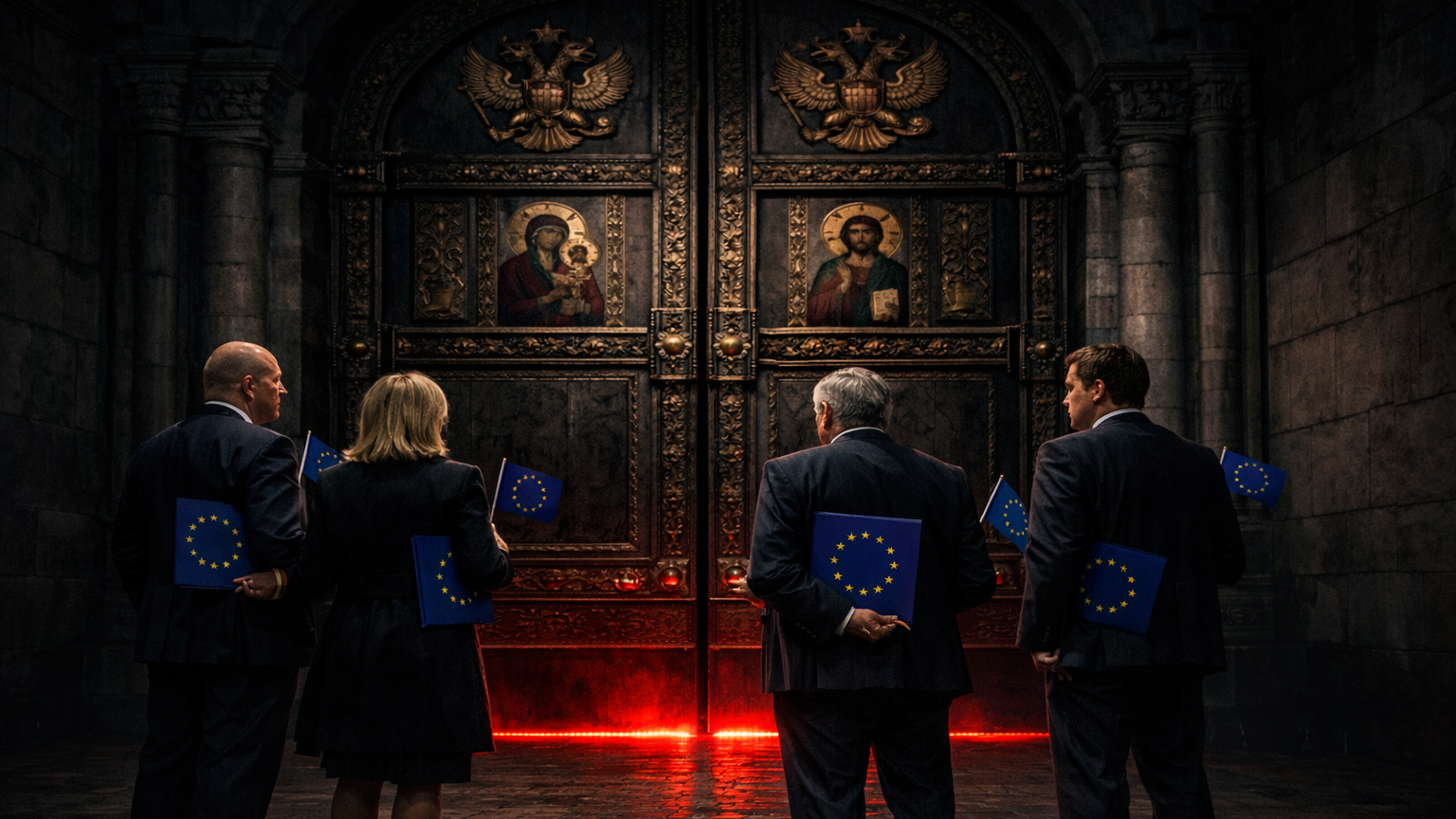
Currently, Europe lacks a strategy for addressing Russia. It has only a series of reactions. Announcements. Summits. But there is no clear line of conduct that would make Moscow understand that further aggression will have uncontrollable consequences.
That is why there is constant talk of a "response" to Russian actions, instead of preventing the next ones. This is not caution; it is a lack of political courage.
In the Kremlin, such behavior is interpreted simply as a sign that the West wants to avoid confrontation at any cost and therefore can be pushed further.
One of the most dangerous European delusions is the belief that Russia will "stop" when it runs out of resources or when the war in Ukraine becomes too costly. Russia does not think this way. It does not seek an end to the conflict; it seeks a constant state of tension that justifies internal repression and external aggression.
In this respect, Ukraine is not an exception but a model. If the West does not understand that Russian policy only stops when faced with real pressure, the next crisis will not be a surprise—it will be the result of ignoring the obvious.
A conclusion Europe does not want to hear
Europe does not have to accept this reality, but it must understand it. Russia is not afraid of patience, concern, or “strong” statements. It is only threatened when it loses control over the narrative, space, and initiative.
As long as Europe refuses to think strategically and continues to act only reactively, Moscow will maintain the upper hand. Each new war will simply be a logical continuation of the same mistake.
This is not a call for escalation but a warning against passivity. History shows one thing: empires do not end because they are told they have gone too far.
Kaliningrad as a mirror of Russian politics
If Europe truly wants to understand Russia, it must start using the same language Moscow has used for decades. This is not about force, but about confronting Russia with its own precedents. In this respect, Kaliningrad is not a military problem but a place to see whether Moscow believes in the rules it imposes on others. It is a political mirror.
Kaliningrad is a territory that Russia cannot connect by land to the rest of the country without passing through NATO. It is isolated, dependent on its European surroundings, and exposed to information and standards that have little in common with reality in Moscow. That is precisely why it has become one of the most militarized points in Europe. The militarization of Kaliningrad is not a sign of self-confidence but an attempt to compensate for a lack of political control. Russia has created a model in Ukraine that it can no longer control. Referendums organized under occupation were declared expressions of the “will of the people.” If that principle is valid in Kherson, Zaporizhzhia, or Crimea, then it must be valid everywhere. If not, the plain truth is that referendums are not instruments of democracy but weapons of imperial politics.
In this context, any public discussion about the political status of Kaliningrad—any idea of asking the citizens of that region about their future—is a test the Kremlin does not want to face. This is not because Moscow believes in the will of the people, but rather because it selectively uses referendums as a political tool. When they serve the Kremlin’s interests, they are declared legitimate. When they do not, they are automatically declared illegal and hostile.
However, Europe is hesitant to even consider this logic. It is afraid because it still believes that the stability of the Russian system is more important than exposing its internal contradictions. That is a mistake. Authoritarian systems do not collapse from external pressure; they break when confronted with their own rules.
Talking about Kaliningrad is not about changing borders. It is a conversation about consistency. If Russia claims that referendums are a sacred expression of the people’s will, it must explain why that principle does not apply on its own territory. If it cannot, then it is clear that this is not a matter of law but of force.
This is precisely why the West must not limit itself to reacting. Reactivity is a luxury for those who believe they have time. Russia is not waiting. It is constantly testing, pushing, and measuring. Every time it encounters silence, it takes it as permission.
Raising political issues where Moscow insists on silence is not escalation. It is returning the game to the political sphere from which Russia forcibly removed it. It serves as a means to demonstrate that the rules the Kremlin employs against others cannot continue to be one-sided.
What Europe could (or should) do
If Europe wants to move beyond the role of a passive observer, it must stop thinking solely in terms of reaction. Russia has clearly demonstrated how it understands politics: through precedents, unilateral actions, and imposing the "will of the people" where it serves its interests. At a minimum, Europe should confront Moscow using similar methods.
One way to do this is through a public, political initiative that raises the question of Kaliningrad's status—not as a military issue, but as a matter of principle. If Russia claims that referendums are a legitimate expression of citizens' will, there is no reason to declare such a debate inadmissible in advance.
Europe could propose an international discussion on whether the citizens of Kaliningrad wish to remain part of the Russian Federation or consider alternatives, including the symbolic possibility of returning to German sovereignty. The purpose of such a proposal is not its outcome, but the question it poses: why is a referendum "sacred" only when organized by Moscow and a "crime" when discussed elsewhere?
Russia used referendums in Ukraine as a political weapon, organizing them under occupation and military presence, then declaring them a "historic act of the people." If Russia believes territorial issues are resolved by referendums, then Europe has every right to apply that rule as a political issue, rather than accepting it only when it benefits Moscow. Such an initiative would not be destabilizing but would expose double standards. It would not attack Russia's territorial integrity but would directly confront the contradictions in its own narrative. Authoritarian systems fear most, not force, but questions they cannot control.
For years, Europe has avoided taking political initiative, believing that caution would reduce risk. In practice, the opposite occurs. Russia uses this lack of initiative to expand the space for aggression. Europe fails to understand that the absence of political initiative does not reduce risk but increases it. Russia does not interpret silence as wisdom but as weakness.
If Europe continues to accept the selective application of rules, Russia will continue to maintain its advantage. Kaliningrad is not a matter of dispute but an example of how the Russian narrative remains viable only as long as no one challenges it.
 761 views